
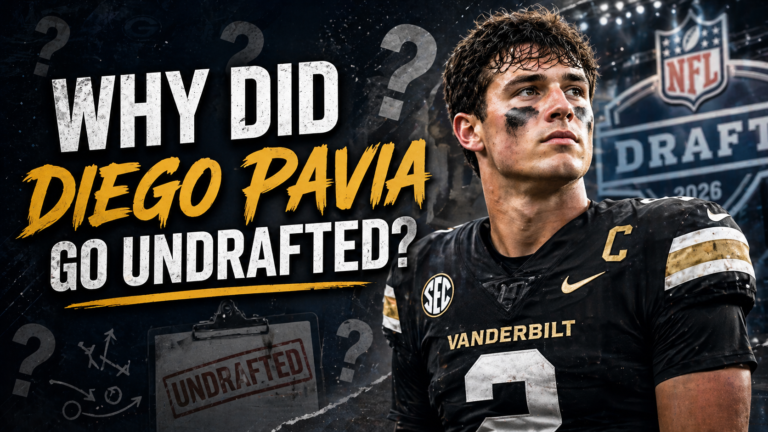
When the 2026 NFL Draft wrapped up on Saturday, one name was conspicuously absent from the selection list: Diego Pavia. The former Vanderbilt quarterback — a Heisman Trophy finalist who helped transform one of the SEC’s most downtrodden programs — became the first Heisman finalist to go undrafted since Northern Illinois quarterback Jordan Lynch in 2014. It left fans, analysts, and even players like Deion Sanders asking the same question: how does that happen?
3,539Passing Yards
29TD Passes
70.6%Completion %
862Rushing Yards
10–3
The stats tell the story of a dominant college quarterback. In the 2025 season at Vanderbilt, Pavia led the SEC in completion percentage, passing touchdowns, and yards per attempt. His 4,402 total yards accounted for more than 70% of Vanderbilt’s entire offense. He led the Commodores to their first 10-win regular season in program history and finished second in Heisman voting, behind only Fernando Mendoza — who went No. 1 overall to the Las Vegas Raiders.
And yet, the NFL passed. All 32 teams. Every single round. Here’s why.
The Size Problem
The most glaring issue was one Pavia could do nothing about: his height. While Vanderbilt officially listed him at 6 feet, his measurement at the NFL Scouting Combine came in at 5-foot-9 and 7/8 inches — the shortest of any player at the combine, by more than two inches. His Senior Bowl listing was even shorter at 5-foot-9 7/8, which would have made him shorter than both Bryce Young and Kyler Murray.
Size by comparison
Kyler Murray, a No. 1 overall pick, stands 5-foot-10 with elite athleticism and arm length. Murray’s measurables were closer to Pavia’s, but he compensated with rare physical tools. Dillon Gabriel, considered short by NFL standards, still listed a full inch taller than Pavia with an arm length an inch longer. Bryce Young’s arm measured two inches longer than Pavia’s.
In the NFL, passing windows are tighter, defensive linemen have longer arm spans, and quarterbacks must routinely deliver throws over the line of scrimmage from the pocket. Short quarterbacks can succeed — but scouts typically require elite arm talent, rare processing speed, or exceptional athleticism to offset the disadvantage. In Pavia’s case, the arm strength and processing didn’t provide that offset.
A College System That Didn’t Translate
Beyond size, many scouts concluded that Pavia’s game was built for college football specifically — not the NFL. His brilliance came from extending plays, manufacturing rushing production, and stressing defenses with improvisation and toughness. NFL teams questioned whether his arm talent and throwing lanes would translate to a league where those avenues close much faster.
“His processing isn’t quite NFL-caliber, nor is his arm strength, and even his athleticism might not be as prevalent against NFL talent.”
— PFSN scouting report
Pavia accumulated over 10,000 passing yards and 3,000 rushing yards across four college seasons, but the dual-threat formula that made him a nightmare in the SEC raised questions about positional fit in a league where role clarity matters as much as production.
Age and Off-Field Concerns
Pavia entered the 2026 draft at 24 years old — older than most prospects due to his winding path through JUCO at New Mexico Military Institute, New Mexico State, and finally Vanderbilt. He also had to sue the NCAA for a sixth year of eligibility, arguing that counting his JUCO seasons toward his eligibility clock was a violation of antitrust law. A federal judge agreed and granted the injunction, but the fight added to a complicated profile for NFL decision-makers.
The maturity question
After finishing second in Heisman voting, Pavia was photographed at a New York club next to a sign reading an expletive directed at Indiana. He also posted inflammatory content on Instagram targeting Heisman voters before later apologizing. At the combine, when asked about the controversy, Pavia joked that his frontal lobe was still developing. Teams noticed. His brothers’ repeated law enforcement attention at Vanderbilt games also drew scrutiny from scouts.
These incidents, combined with concerns about his willingness to accept a backup role and the media circus he might generate, drew unfavorable comparisons to Shedeur Sanders — whose own draft stock slipped to the fifth round in 2025 partly due to similar concerns about off-field noise.
No Agent, No Leverage
A viral pre-draft interview with Jon Gruden appeared to suggest Pavia was entering the process without a traditional agent — a decision that likely cost him leverage in the undrafted free agent market. While his camp later clarified that the agent-free comments were specifically tied to his NIL situation, the confusion may have slowed post-draft negotiations. As of Sunday, Pavia had not signed as an undrafted free agent — an unusual outcome for a player of his profile.
What’s next
On Sunday, ESPN’s Adam Schefter reported that Pavia accepted an invitation to join the Baltimore Ravens at their rookie minicamp. The Ravens — home of Lamar Jackson and an offense built around quarterback athleticism and designed runs — may be a natural fit for a Taysom Hill-style developmental role. It’s not the draft call Pavia wanted, but with the chip still firmly on his shoulder, it’s not the end of the story either.
Pavia’s story is one of the most remarkable in recent college football history: a kid who earned a wrestling state title, bet on himself at JUCO, won a national title, sued the NCAA, and transformed a laughingstock program into a 10-win SEC contender. The NFL Draft snub stings, but it fits the pattern of a career defined by proving doubters wrong. The Ravens minicamp is just the next door to kick down.
When the 2026 NFL Draft wrapped up on Saturday, one name was conspicuously absent from the selection list: Diego Pavia. The former Vanderbilt quarterback — a Heisman Trophy finalist who helped transform one of the SEC’s most downtrodden programs — became the first Heisman finalist to go undrafted since Northern Illinois quarterback Jordan Lynch in 2014. It left fans, analysts, and even players like Deion Sanders asking the same question: how does that happen?
3,539Passing Yards
29TD Passes
70.6%Completion %
862Rushing Yards
10–32025 Record
The stats tell the story of a dominant college quarterback. In the 2025 season at Vanderbilt, Pavia led the SEC in completion percentage, passing touchdowns, and yards per attempt. His 4,402 total yards accounted for more than 70% of Vanderbilt’s entire offense. He led the Commodores to their first 10-win regular season in program history and finished second in Heisman voting, behind only Fernando Mendoza — who went No. 1 overall to the Las Vegas Raiders.
And yet, the NFL passed. All 32 teams. Every single round. Here’s why.
The Size Problem
The most glaring issue was one Pavia could do nothing about: his height. While Vanderbilt officially listed him at 6 feet, his measurement at the NFL Scouting Combine came in at 5-foot-9 and 7/8 inches — the shortest of any player at the combine, by more than two inches. His Senior Bowl listing was even shorter at 5-foot-9 7/8, which would have made him shorter than both Bryce Young and Kyler Murray.
Size by comparison
Kyler Murray, a No. 1 overall pick, stands 5-foot-10 with elite athleticism and arm length. Murray’s measurables were closer to Pavia’s, but he compensated with rare physical tools. Dillon Gabriel, considered short by NFL standards, still listed a full inch taller than Pavia with an arm length an inch longer. Bryce Young’s arm measured two inches longer than Pavia’s.
In the NFL, passing windows are tighter, defensive linemen have longer arm spans, and quarterbacks must routinely deliver throws over the line of scrimmage from the pocket. Short quarterbacks can succeed — but scouts typically require elite arm talent, rare processing speed, or exceptional athleticism to offset the disadvantage. In Pavia’s case, the arm strength and processing didn’t provide that offset.
A College System That Didn’t Translate
Beyond size, many scouts concluded that Pavia’s game was built for college football specifically — not the NFL. His brilliance came from extending plays, manufacturing rushing production, and stressing defenses with improvisation and toughness. NFL teams questioned whether his arm talent and throwing lanes would translate to a league where those avenues close much faster.
“His processing isn’t quite NFL-caliber, nor is his arm strength, and even his athleticism might not be as prevalent against NFL talent.”
— PFSN scouting report
Pavia accumulated over 10,000 passing yards and 3,000 rushing yards across four college seasons, but the dual-threat formula that made him a nightmare in the SEC raised questions about positional fit in a league where role clarity matters as much as production.
Age and Off-Field Concerns
Pavia entered the 2026 draft at 24 years old — older than most prospects due to his winding path through JUCO at New Mexico Military Institute, New Mexico State, and finally Vanderbilt. He also had to sue the NCAA for a sixth year of eligibility, arguing that counting his JUCO seasons toward his eligibility clock was a violation of antitrust law. A federal judge agreed and granted the injunction, but the fight added to a complicated profile for NFL decision-makers.
The maturity question
After finishing second in Heisman voting, Pavia was photographed at a New York club next to a sign reading an expletive directed at Indiana. He also posted inflammatory content on Instagram targeting Heisman voters before later apologizing. At the combine, when asked about the controversy, Pavia joked that his frontal lobe was still developing. Teams noticed. His brothers’ repeated law enforcement attention at Vanderbilt games also drew scrutiny from scouts.
These incidents, combined with concerns about his willingness to accept a backup role and the media circus he might generate, drew unfavorable comparisons to Shedeur Sanders — whose own draft stock slipped to the fifth round in 2025 partly due to similar concerns about off-field noise.
No Agent, No Leverage
A viral pre-draft interview with Jon Gruden appeared to suggest Pavia was entering the process without a traditional agent — a decision that likely cost him leverage in the undrafted free agent market. While his camp later clarified that the agent-free comments were specifically tied to his NIL situation, the confusion may have slowed post-draft negotiations. As of Sunday, Pavia had not signed as an undrafted free agent — an unusual outcome for a player of his profile.
What’s next
On Sunday, ESPN’s Adam Schefter reported that Pavia accepted an invitation to join the Baltimore Ravens at their rookie minicamp. The Ravens — home of Lamar Jackson and an offense built around quarterback athleticism and designed runs — may be a natural fit for a Taysom Hill-style developmental role. It’s not the draft call Pavia wanted, but with the chip still firmly on his shoulder, it’s not the end of the story either.
Pavia’s story is one of the most remarkable in recent college football history: a kid who earned a wrestling state title, bet on himself at JUCO, won a national title, sued the NCAA, and transformed a laughingstock program into a 10-win SEC contender. The NFL Draft snub stings, but it fits the pattern of a career defined by proving doubters wrong. The Ravens minicamp is just the next door to kick down.