
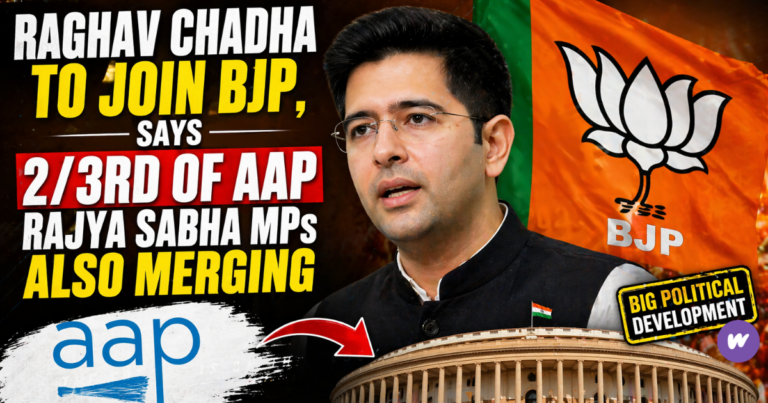
In what can only be described as a seismic rupture in Indian politics, Raghav Chadha — one of the most recognisable faces of the Aam Aadmi Party — has announced his decision to join the Bharatiya Janata Party, taking with him a stunning two-thirds of AAP’s Rajya Sabha MPs. The announcement, made at a press conference in Delhi on Friday, sent shockwaves through the political establishment and delivered what may well be the most devastating blow to Arvind Kejriwal’s party since its meteoric rise in 2013.
The Announcement That Changed Everything
Standing alongside fellow Rajya Sabha MPs Sandeep Pathak and Ashok Mittal, Chadha pulled no punches. “We have decided that we, the two-third members belonging to the AAP in Rajya Sabha, exercise the provisions of the Constitution of India and merge ourselves with the BJP,” he declared — a carefully worded statement invoking the constitutional provision that permits a two-thirds parliamentary group to legally merge with another political party without attracting disqualification under the anti-defection law.
The group of seven defecting MPs includes, beyond Chadha, Pathak, and Mittal: Swati Maliwal, former cricketer Harbhajan Singh, Rajinder Gupta, and Vikramjit Singh Sahney. With AAP holding ten Rajya Sabha seats in total, seven departures constitute exactly the two-thirds threshold required to validate the merger under the Tenth Schedule of the Constitution. The signed letters and documents were reportedly submitted to the Rajya Sabha Chairman the same morning.
A Fifteen-Year Goodbye
For Raghav Chadha, this was not simply a political calculation — or at least, that is how he framed it. Speaking with visible emotion, he said the AAP, to which he had given fifteen years of his youth, had “completely deviated from its principles, values, and core morals.” He described the party as no longer working in the national interest but for personal gain, and delivered a phrase that is sure to be quoted for years in political circles: “I am the right man in the wrong party.”
Chadha’s grievances had been simmering publicly for weeks. Earlier this month, the AAP had removed him as its deputy leader in the Rajya Sabha — a move he described as an attempt to silence him in Parliament. He had also reportedly been denied adequate speaking time in the House. In a pointed Instagram video titled “Voice Raised, Price Paid”, Chadha shared clips of his parliamentary work, signalling publicly that a break was coming. “I did not want to be a part of their crimes,” he said on Friday. “I was not eligible for their friendship because I was not a part of their crime.”
AAP Hits Back: “Operation Lotus”
The AAP was quick to respond — and equally blunt. Senior party leader Sanjay Singh accused the BJP of orchestrating what he called “Operation Lotus,” a term used to describe the ruling party’s alleged strategy of using central investigative agencies to coerce or poach opposition legislators. “The BJP used the state machinery to create fear and initiate Operation Lotus,” Singh charged. He claimed the Enforcement Directorate and the CBI were being weaponised not just to peel away MPs but to destabilise the Bhagwant Mann-led government in Punjab.
Singh also turned personal. “How much love did they show by sending him to the Rajya Sabha? And now, he has gone into the lap of the BJP,” he said, referring to Chadha. He called the seven departing MPs “traitors” who had “stabbed the people of Punjab in the back.”
Arvind Kejriwal himself entered the fray, accusing the BJP of betraying Punjab and suggesting the entire episode was engineered from above. The timing, coming just weeks after the AAP stripped Chadha of his party post, has fuelled speculation about whether the defections were part of a coordinated plan set in motion much earlier.
Why This Matters — And Why Punjab Is at the Centre of It
The significance of this split extends well beyond parliamentary arithmetic. Most of the seven departing MPs have strong connections to Punjab, the one major state where AAP currently holds power through the Bhagwant Mann government. By securing a two-thirds merger, the BJP achieves multiple objectives simultaneously: it weakens AAP’s presence in the Rajya Sabha, potentially undermines the Punjab government’s political backing at the national level, and delivers a powerful narrative win just as the opposition has been trying to project unity.
The constitutional mechanism invoked — the Tenth Schedule merger clause — is no accident. By clearing the two-thirds bar, the defecting MPs insulate themselves from disqualification proceedings that would otherwise threaten their seats. The paperwork filed with the Rajya Sabha Chairman on Friday morning was as legally precise as it was politically explosive.
A Party at a Crossroads
For AAP, the crisis could not come at a worse moment. Already reeling from poor performances in recent state elections and internal battles over leadership style, the party now faces the prospect of being reduced to a rump in the Rajya Sabha. Three MPs remain — a weakened group that will struggle to exert meaningful parliamentary pressure.
What makes this particularly painful for the AAP ecosystem is the profile of those who have left. These were not peripheral figures. Raghav Chadha was among the party’s most effective public communicators. Sandeep Pathak served as a key organisational backbone. Swati Maliwal, once a prominent voice on women’s rights issues championed under the AAP umbrella, had already been at odds with party leadership.
The Road Ahead
Raghav Chadha joining BJP marks the end of an era — and the beginning of a complicated new chapter for Indian opposition politics. Whether his stated reasons reflect genuine disillusionment or are a post-hoc rationalisation for a calculated move, the political damage to AAP is real and immediate.
For the BJP, this is a significant acquisition of faces, narratives, and — perhaps most importantly — the constitutional legitimacy of a formal parliamentary merger rather than individual defections. The coming weeks will test whether AAP can contain the fallout, and whether Bhagwant Mann’s government in Punjab can weather the pressure that is clearly building around it.
One thing is certain: April 24, 2026 will be remembered as the day AAP’s parliamentary story changed forever.
This article is based on breaking news reported on April 24, 2026.